Landscape: Revealed and Reframed
Landscape: Revealed and Reframed features contemporary perspectives on landscape in photography, print, painting, and drawing by four Connecticut artists. The exhibition will open with a reception and artist talk on Wednesday, September 9 from 5:30 - 7:30 pm and will be on view in the gallery through October 11, Thursday - Sunday, 12 - 4 pm.
Daniel Buttrey presents Myron’s Farm, a photographic record of the artist’s walk along the perimeter of the farm after an early morning encounter with the disgruntled landowner. Buttrey engages the viewer in an experience of perception and the passing of time in the form of an accordion book, while questioning ideas of ownership, infringement, and surveillance. His work is also a reaction to “the threat of violence, and a reminder that when someone tells you they want to shoot you, you should listen”.
Ted Hendrickson exhibits photographic works from two series which reflect his deep interest in durations of time, and changes in the human occupied landscape. In two panoramic images from his Glacial Erratics series, we consider geologic time in our everyday surroundings as represented in “the boulder’s implacable presence… a testament to the power of glacial ice.” Six photographs from his series From my Porch reflect day to day changes, in the variety of light and growth over the seasons, in a single suburban view.
Pamela Marks creates paintings that reflect her personal experience of the landscape and the predicament of climate change. In her small paintings on book pages from the Living Earth Series, published in 1975 and focused on our world’s interconnectedness and precarious balance, Marks employs an orderly use of color and geometric abstraction to heighten the pages’ emotional impact. Her larger paintings on cyanotypes use geometric patterns that fragment the landscape and create a barrier between us and nature. In these works, the artist uses color patterns that “reference my experiences while walking in the forest, and embody elements of time, sequence, and rhythm.”
Timothy McDowell’s landscapes are inventive and mysterious, incorporating geometric structures that encapsulate fragments of an idealized landscape and suggest biospheres. The artist describes his work as developing from “a compulsive preoccupation, a fixation, with nature and landscape…and a curiosity and fascination with process.” His works in the exhibition are created with a variety of techniques and media, drawing in red chalk and conté; copper plate etching; and oil painting combined with cyanotype, a process which the artist defines as representing an “integration of the lens and the brush”.

Let’s Have a Conversation at the Dining Table
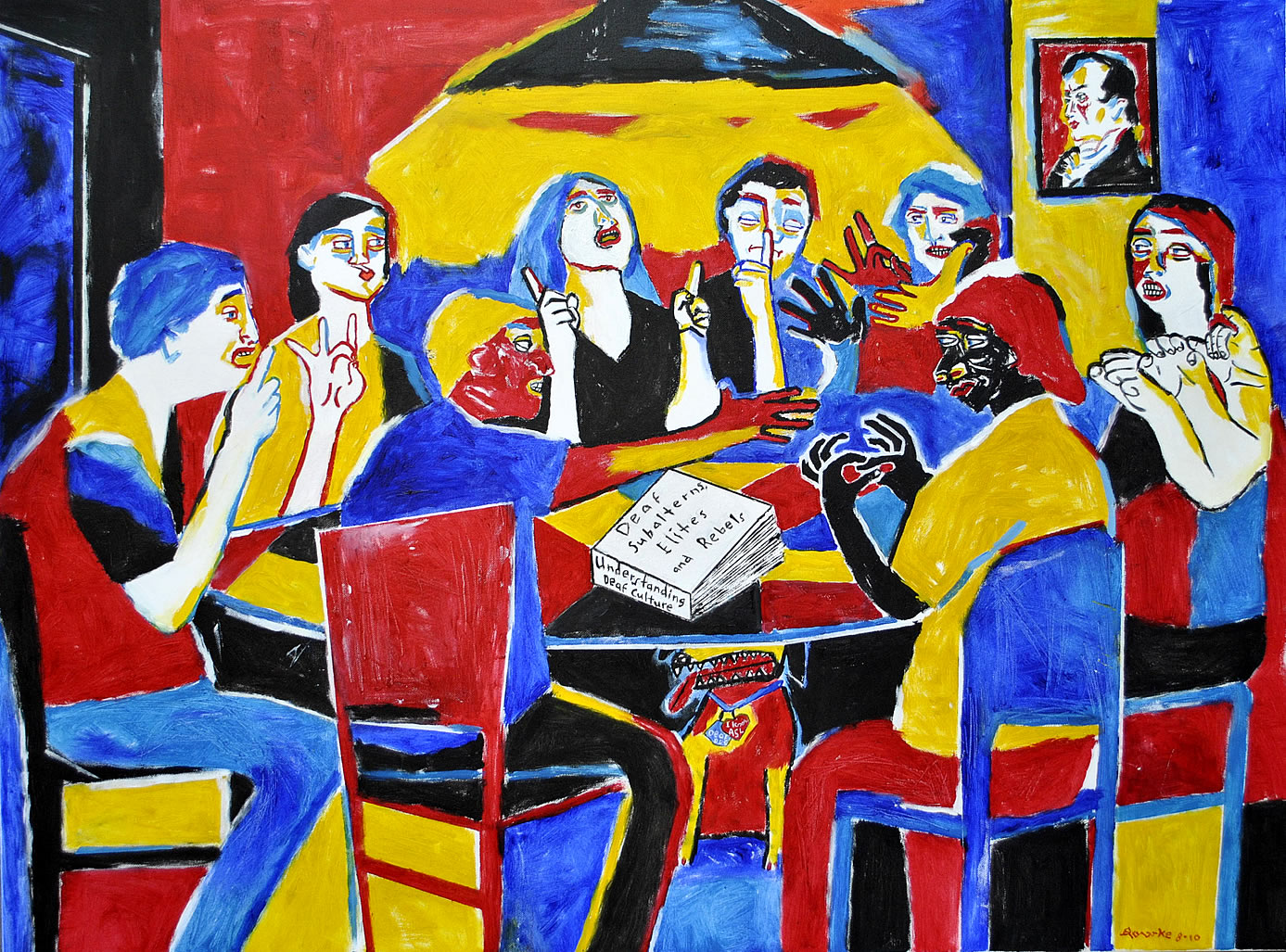
Let’s Have a Conversation at the Dining Table, a groundbreaking exhibition curated by UConn MFA candidate Dakota Halliburton, facilitates a contemporary art dialogue between Deaf and hearing artists. This exhibition of artists from the United States, Australia, India, and Canada, invites viewers into a shared space with nine artists who connect through life experiences and creative conversations.
Through symbolism, color, and visual narrative, Nancy Rourke’s paintings explore social, political, and cultural realities that have shaped Deaf lives across history and continue to influence our communities. Her work centers on the themes of resistance, affirmation, and liberation within the Deaf experience. Janhavi Khemka’s installation Letter to My Mother, a projection on a low platform adorned with an animated pattern of lips is described by the artist as “reminiscent of the mat on which we once sat together to learn the art of lip-reading.” The beautiful and award-winning video The Beauty of Being Deaf, by Chellaman, features a Deaf cast performing a poem in American sign language underwater. Sonja Czekalski’s Pick Your Poison transforms the ritual of drinking tea into a meditation on choice, memory and women’s knowledge. In her series You Get That from Me and The Sleep in My Eye, Chelsea Taylor explores the interwoven relationship between the tangible and the unseen. She focuses on her personal experiences while simultaneously examining the topics within them that relate to broader problems affecting broader populations. Sophie Pearson, who presents paintings in oils, writes “Art is no longer a tool for distraction, but a tool for exposure, leading me to confront my darker memories and share them with those who they reach.” Laurie Landry’s oil paintings explore how meaning is constructed through gesture, posture, movement, and spatial relationship rather than spoken language alone. Charlotte Rose Eschelman presents photographs that explore the impossibility of knowing a person fully and the nonlinearity of personal histories. The artist writes, “The photographs contemplate what we do with what we are given, how trauma is inherited and passed to the next generation through the body, and the complex intimacy of the mother-child relationship.” In Sue Jo Wright’s Endless Conversation, fabric becomes a vessel for the enduring exchange of joy and pain, weaving together a narrative of conversation through stitching. Her piece, Disposable Feelings, defines her feelings of isolation, diminishment, and insignificance, represented by the triviality of a symbolic handkerchief.